OpenAI Agents API: Managed Agentic Infrastructure and What It Changes for Developers
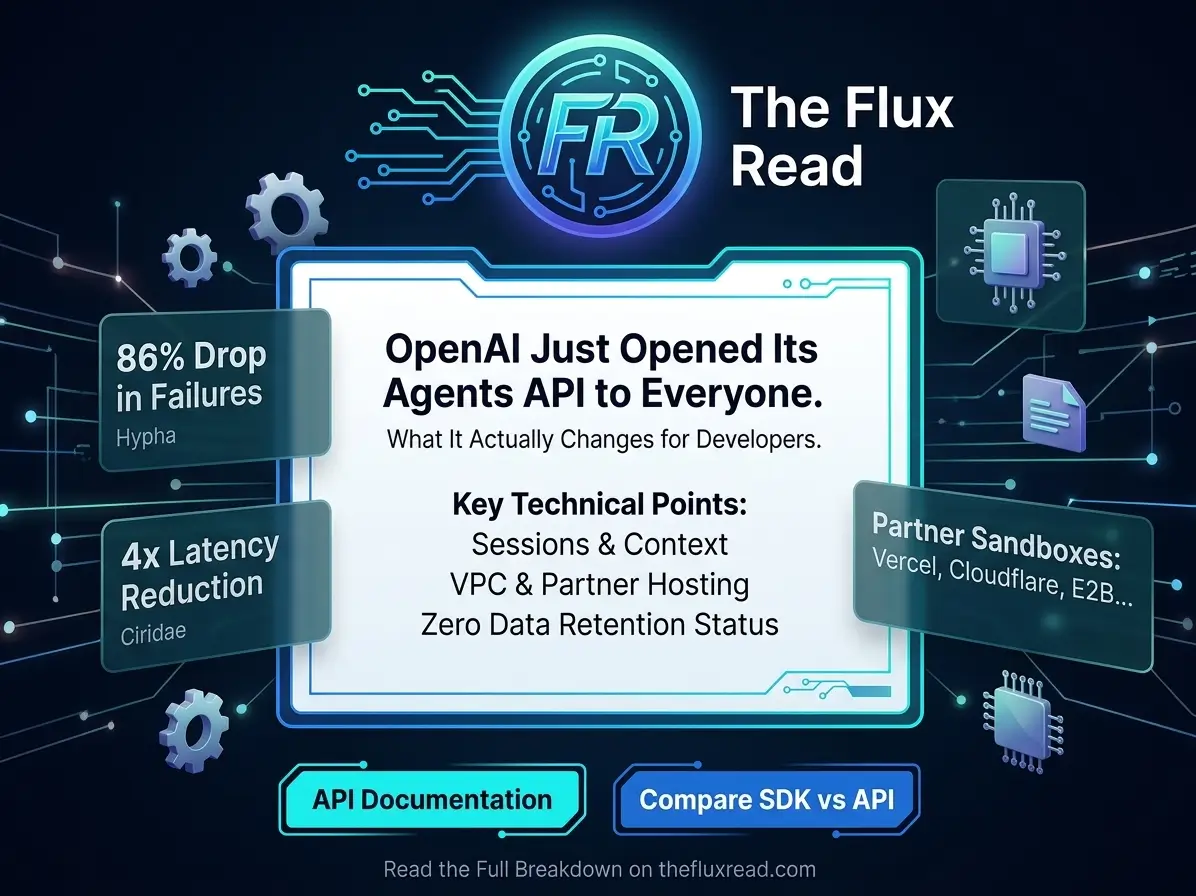
On September 10, 2026, OpenAI launched its managed Agents API in public beta. It exposes the exact framework behind Codex and ChatGPT for Work, allowing developers to run multi-day, complex agentic tasks without building custom orchestration from scratch.
Here is an architectural breakdown of what shipped, compute options, performance benchmarks, compliance blockers, and how it compares to the Agents SDK.
Key Highlights at a Glance
Feature | Details |
Core Components | Agents, Sessions, Sandboxes, and Tools (MCP support). |
Hosting | OpenAI Sandbox, Custom VPC, or 9 partner sandboxes. |
Pricing | No harness fee; pay standard model tokens + tool execution. |
Compliance Blocker | US-only processing; No Zero Data Retention (ZDR) yet. |
What Actually Shipped?
Building production AI agents is rarely a model intelligence issue—it is an infrastructure issue. Homemade agent loops frequently fail on session persistence, context window compaction, and dropped network connections.
OpenAI abstracts this complexity into four primitives:
The Agent: Bundles model choices, system instructions, and designated tools.
The Session: Persists execution state across turns to eliminate cold starts.
The Sandbox: Isolated execution compute (hosted by OpenAI, custom VPC, or partners).
The Tools: Native support for Model Context Protocol (MCP) servers and custom functions.
By offloading session continuity, context management, parallel tool calling, and subagent coordination to OpenAI, developers can eliminate months of complex orchestration boilerplate.
Compute Options & Day-One Partners
Rather than locking users into a single cloud, OpenAI supports three execution paths:
OpenAI Managed Sandbox: Zero-infrastructure hosted compute.
Bring Your Own VPC: Execution stays within your own cloud boundary.
Partner Sandboxes: Native integration with 9 specialized platforms: Vercel, Cloudflare, E2B, DigitalOcean, Modal, Oracle, Daytona, Runloop, and Blaxel.
Early Benchmarks
Early customer reports show massive gains in execution stability:
Hypha: Reported an 86% reduction in failed responses after migrating off custom orchestration.
Ciridae: Observed a 4x latency reduction using built-in subagent execution.
Evaluation Scores: Internal evals jumped from 0.71 to 0.85 when handling split-task coordination via managed subagents.
Compliance Blockers & Security Realities
Zero Data Retention (ZDR) Gap: Processing remains US-only, and ZDR is unsupported in public beta. For fintech, healthcare, and enterprise workloads, this is a hard blocker.
Runtime Threat Modeling: Long-running sandboxed execution still requires strict external monitoring and perimeter guardrails.
Agents SDK vs. Agents API
Parameter | Agents SDK | Agents API |
Architecture | Embedded in application logic | Fully managed cloud endpoint |
Control | Maximum execution control | Zero infrastructure overhead |
Best For | Custom, local compute pipelines | Rapid production scaling & stateful workflows |
This article was originally published on The Flux Read. Check out the original post for more deep dives into AI engineering and developer tools.